Philip's poverty and financial insecurity
Of Human BondagePhilip's poverty and financial insecurity are not a brief interruption to his plans but a condition that repeatedly dictates what work he can take, what training he can continue, and what future he can imagine. His movement from hospital medicine to a six-shilling-a-week shop job exposes the distance between professional aspiration and precarious labor; the same poverty also sharpens his understanding of patients whose illnesses and losses cannot be separated from their means of subsistence.
The hospital and the limits of medical care
At St. Luke's, Philip encounters poverty first as a clinical reality organized by the hospital's crowded rooms, long benches, and queues. Patients wait with bottles and gallipots, while clerks record their names, ages, occupations, and diagnoses. The staff must distinguish those who can pay for private care from those entitled to charitable treatment. Dr. Tyrell watches for what he considers fraud among patients whose clothes or jewelry suggest that they can afford a doctor, and sometimes refuses to see them. The hospital's charitable function thus depends on judgments about visible need and respectability, even as the waiting room gathers people whose circumstances are far from uniform.
The difference between patients' illnesses reflects the material conditions of their lives. Among the men, ailments are commonly associated with excessive alcohol; among the women, defective nourishment is prominent. In one case, Dr. Tyrell tells Philip that a woman is likely to die as her brother and sister did, because the treatment that might help a richer patient is beyond her reach. He says there is nothing that can be done for people who cannot go to St. Moritz. The statement makes the boundary of medical intervention a boundary of wealth: the disease is not simply a biological problem, since access to the conditions for treatment is itself classed.
A laborer with persistent pain brings that structural limit into still sharper focus. He is strong and in the prime of life, but the only chance the physician can offer is complete rest and a much lighter job. The man answers that there are no light jobs in his trade. His likely death is therefore not presented as a mysterious failure of science alone; it follows from his place in a complex system that leaves him little power to change his working conditions. Philip's clinical education repeatedly confronts him with this gap between what a prescription requires and what a poor patient can actually do.
From medicine to a precarious wage
When Philip's finances force him away from hospital work, Athelny tries to find him a position at Lynn and Sedley. He first imagines that Philip's Paris training may secure a well-paid post designing costumes and drawing posters. Philip makes a summer-sale poster, but the manager admires it without offering him work in that department. The available opening is instead as a shop-walker. Athelny has encouraged expectations of something better, yet his own limited resources mean he cannot continue supporting Philip indefinitely. The employment offers a way to earn, but it is not the artistic or medical future Philip had hoped to pursue.
The shop's deductions make the small wage smaller before Philip can use it. Two shillings each month go toward a club that provides medical attendance and access to a library of worn novels; another four shillings are stopped for washing. Philip learns that one quarter of his six shillings a week will never reach him. The staff's social evenings are partly funded by their own wages, while their shared sleeping quarters and cheap supper make clear how little separates employment from bare subsistence. Even the men who have work depend on credit for food near the end of the month.
After his first month, Philip has only eighteen shillings left. This is the first money he has earned, but it gives him dismay rather than pride because the sum makes his lack of prospects concrete. He takes fifteen shillings to Mrs. Athelny to repay part of what he owes, and she accepts only half a sovereign. At that rate, he calculates, settling his debt will take eight months. Her kindness relieves immediate pressure without dissolving the obligation or restoring his independence.
The job is regular, but its security is conditional. When Philip considers asking for a two-shilling weekly increase, he knows that a request for a raise may end with his notice: the manager treats dissatisfaction as evidence that an assistant will not work properly. Philip also fears that he would struggle to find another post as a designer, since many people can draw as well as he can. A queue of about a hundred applicants for work at the same six-shilling wage makes the threat tangible. Seeing their envious looks at his employment, he abandons the thought of risking it. The prospect of a marginal increase cannot be separated from the possibility of losing the only wage he has.
Debt, dependence, and the narrowed future
The Athelnys provide a counterweight to the shop's crowded routine. Mrs. Athelny treats Philip with motherly kindness, worries that he should eat well, and allows him to repay his debt gradually. Sundays in their friendly house become a joy; sitting in the Spanish chairs and talking with Athelny offers a form of companionship absent from the sleeping room he shares with other men. Yet the refuge also reveals the extent of his dependence. His gratitude and relief coexist with the knowledge that he cannot make a life there indefinitely, and the monotony of his circumstances begins to appall him.
Philip cannot sustain his medical reading after the exhausting day at the shop. He dreams that he is back in the hospital wards, then wakes to the crowded room and the fact that he does not know when he can resume his course. His imagined future contracts into an endless repetition of giving directions to customers and hoping not to be dismissed. Even that modest security seems temporary: Lynn and Sedley have promised to reinstate staff who return from the war, so Philip anticipates that other assistants may lose their places. Poverty is not only the lack of money in hand; it is the inability to rely on a job, to continue training, or to plan beyond the next threat.
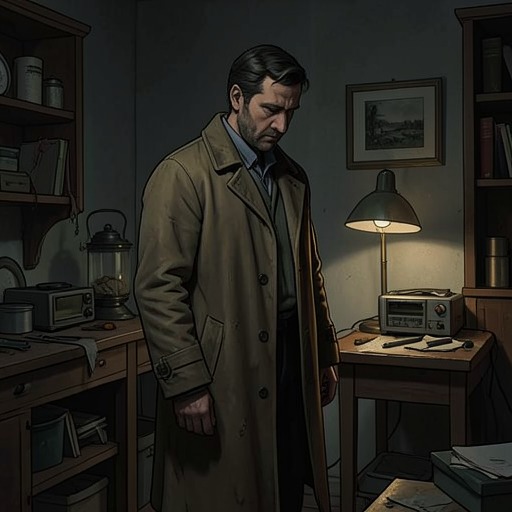
He comes to regard his uncle's death as the one event that might release him. He expects that an inheritance of a few hundred pounds could let him finish medical school, and he calculates how soon he might return to the hospital and take his examinations in midwifery, medicine, and surgery. His hope becomes bound to an event he cannot control, and he finds himself wishing for the cold and rain that might worsen his elderly uncle's chronic bronchitis. He even fears that the money might be left to the parish or church instead. If the inheritance fails to materialize, he imagines suicide as an escape from a life he cannot endure. These thoughts show how sharply financial insecurity narrows his sense of agency: the continuation of a vocation and even the tolerability of life seem to depend on money he does not possess and a death he only anticipates.
Poverty as a social and bodily condition
Philip's work in the hospital and later in the district gives him knowledge of deprivation beyond his own precariousness. His patients are not merely cases to be diagnosed: through their faces, speech, trades, and evasions, he learns how illness is entangled with the conditions under which people live. He feels at ease with them and discovers that they trust him when he asks questions. This direct contact differs from his earlier life among artistic ideas and gives him a sense of practical engagement with other people. The contrast does not erase the power imbalance of medicine, but it shows his developing attention to the lives behind the recorded diagnosis.
As a district trainee, Philip attends an average of three confinements a day. He is summoned at night and walks through deserted streets to laboring families' homes, sometimes a mile or more away. He waits in cramped rooms with the women, their mothers, and the midwife; they accept his presence because he is gentle, patient, and willing to share their tea and bread and dripping. The houses can be filthy and airless, their rooms crowded with whole families, yet some dilapidated interiors preserve carved oak balusters and old paneling. The contrast between architectural remnants and present overcrowding gives material form to lives reduced to hand-to-mouth existence.
The difficulties surrounding childbirth extend beyond the medical event. Hospital practice requires mothers to remain in bed for ten days, but families still need their children cared for and their meals prepared. No one will do such work without payment, and the women tell Philip they cannot afford help. The requirement meant to protect a mother's health therefore meets the household's need for unpaid labor and the absence of affordable support. Philip learns these conditions by listening and by interpreting what the women leave unsaid; what he sees is not simply individual hardship but a distance between the poor and the classes who offer charitable supervision without sharing the same daily constraints.
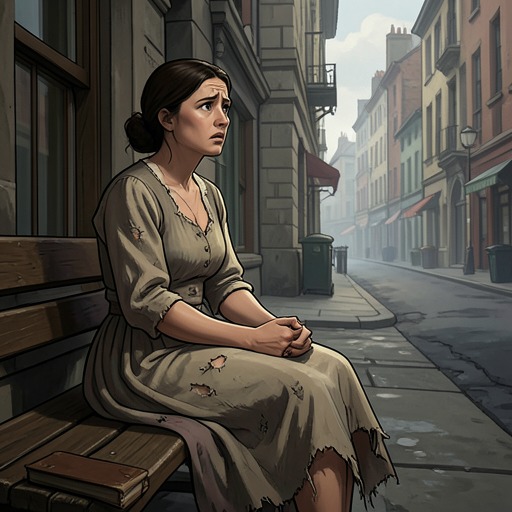
The extremity of that distance is made visible in the death of a young woman after childbirth. As dawn approaches, Philip watches her husband stand beside the cheap iron bed, stunned and unable to find anywhere to lie down. The loss is immediate, but Philip also thinks of the life she might have faced: repeated childbirth, poverty, bodily wear from labor, insecure work in old age, and eventual reliance on the workhouse or her children's charity. He does not treat this imagined future as a reason to dismiss her death; rather, it exposes the grinding conditions that would have shaped her survival. Against the bereaved man's bewilderment and the room's bareness, the beauty of the morning and the river strikes Philip with force. The encounter binds his recognition of poverty's cruelty to a perception that beauty can still command attention, without pretending that beauty repairs the material deprivation he has witnessed.